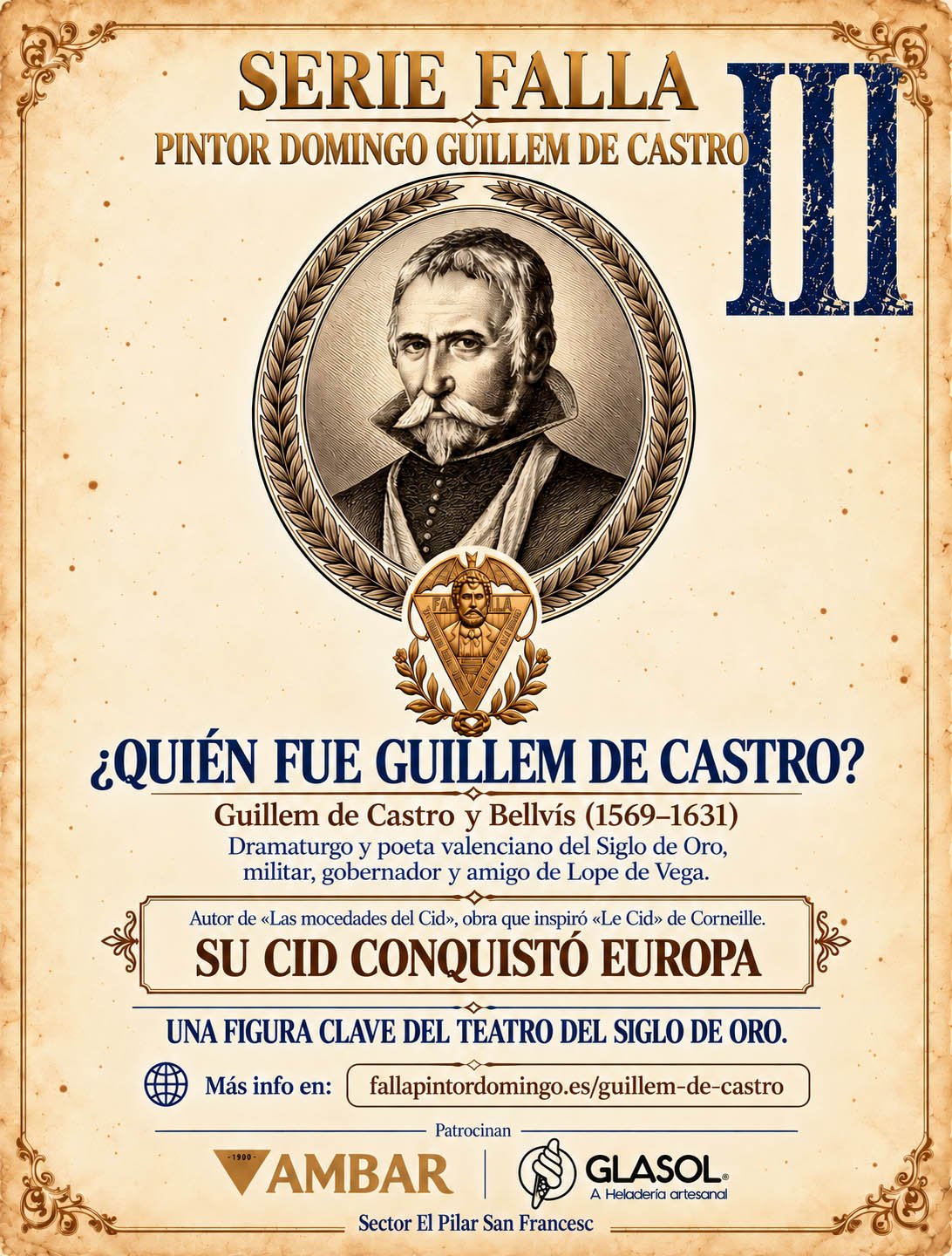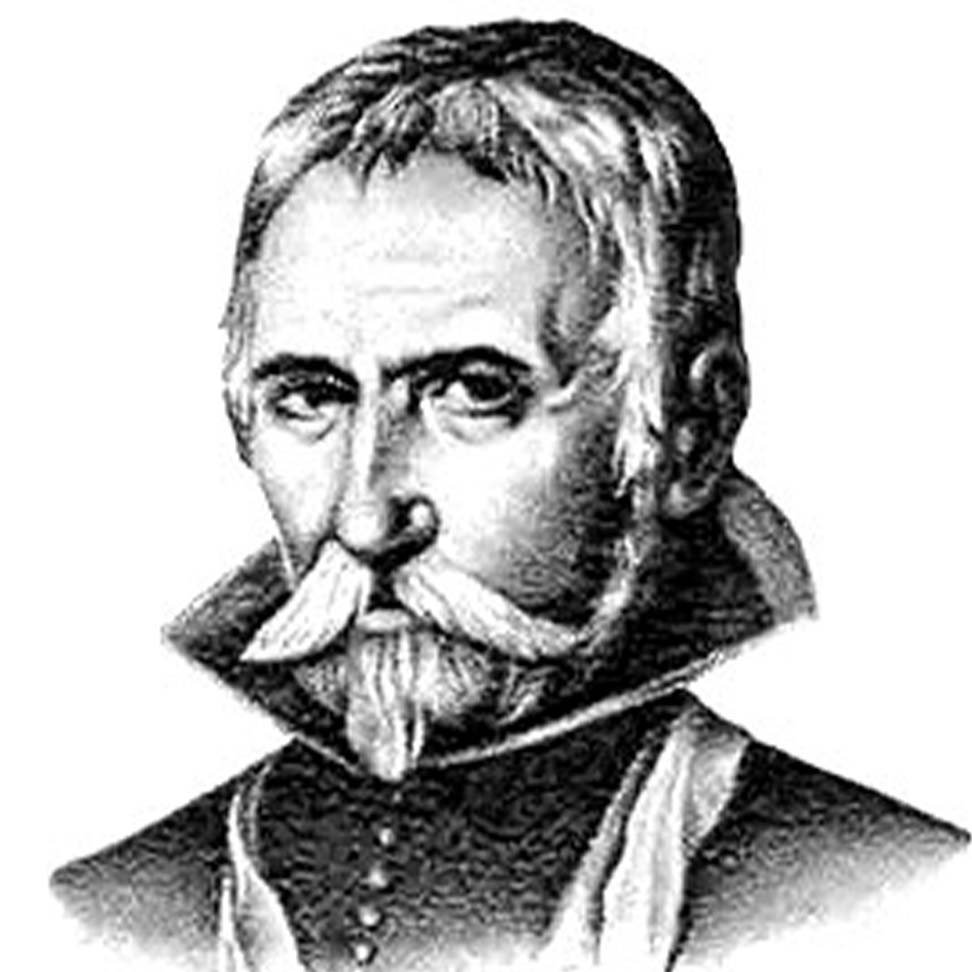

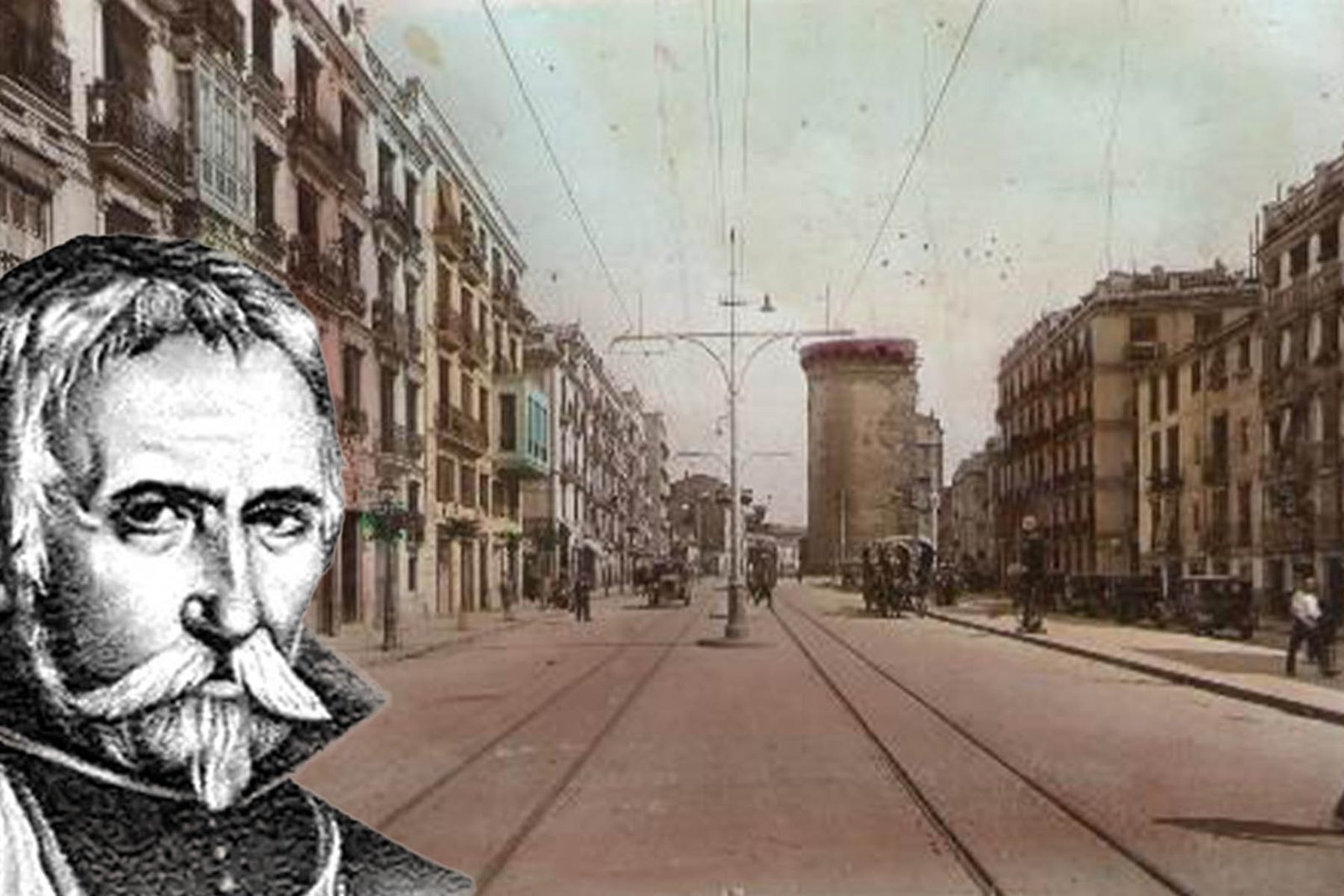
If someone told us that a Golden Age playwright had been a cavalry captain, a governor in Italy, a member of a literary academy, the protégé of a duke, a friend of Lope de Vega, admired by Cervantes and Gracián, the author of plays about El Cid and, on top of all that, ended his days struggling financially, we might reasonably assume we were looking at the protagonist of a historical drama series.
But no. We are talking about Guillem de Castro, one of the most interesting —and perhaps less well-known today— playwrights of the Spanish Golden Age.
And his life had practically everything: love, war, literature, politics, travel, academies, dukes, kings, betrayals, duels, complicated marriages and, of course, an awful lot of people getting angry over matters of honour.
A Valencian with a sword and a pen
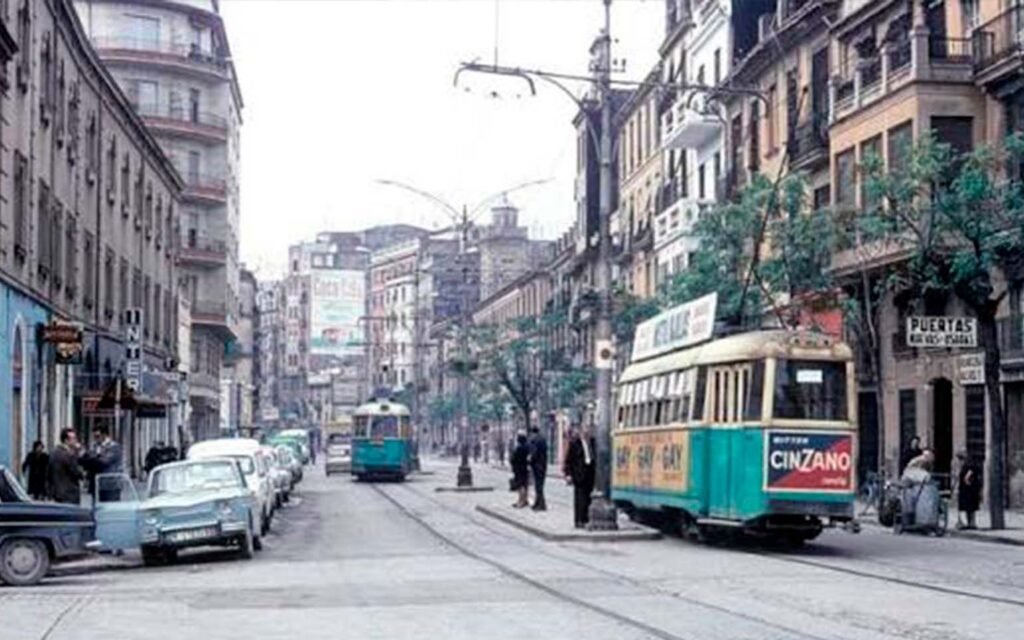
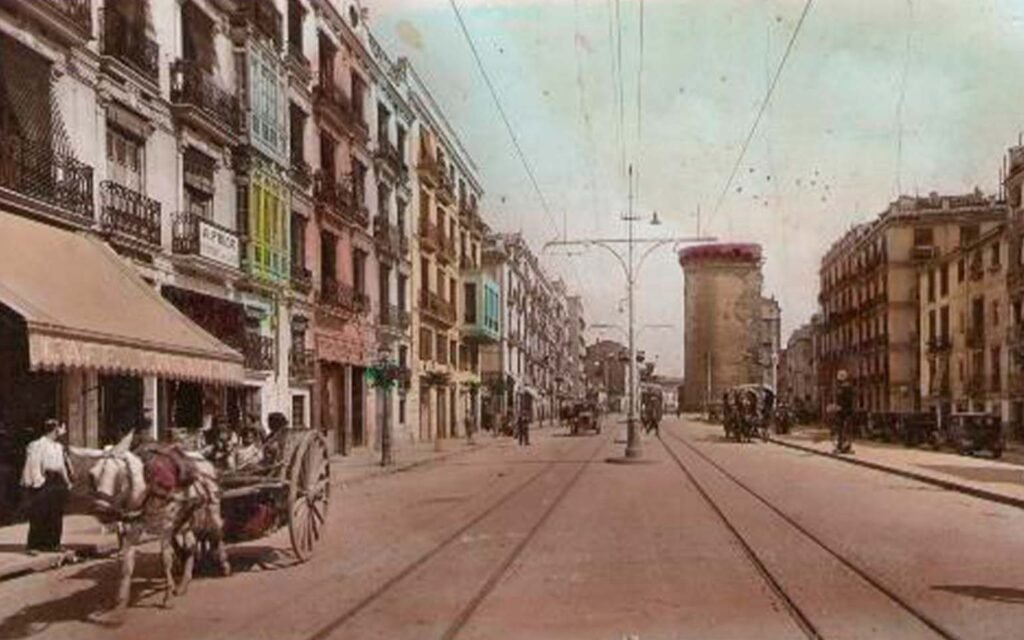
Guillem de Castro y Bellvís was born in Valencia in 1569 into a distinguished family. And judging by what we know of his career, he does not appear to have been one of those writers who spent their entire lives shut away in a room, writing while staring melancholically out of the window.
In his youth, he served as a cavalry captain on the coast and took an active part in Valencian public and cultural life. During the 1590s, he also began to make a name for himself as a poet and attended festivities, literary competitions and academies. In short, Castro led a fairly eventful life.
In 1592, he gave his first poetry reading at the famous Academia de los Nocturnos, a Valencian literary institution where writers and enthusiasts gathered to read and discuss poetry.
The academy’s name already sounds slightly like something out of a Gothic novel: The Nocturnals. You almost expect someone, at the end of the meeting, to say:
“Gentlemen, the poetry has been excellent. Now let us extinguish the candles and go and summon a spirit.”
But they probably just discussed poetry.
He also found time to fall in love, marry and become a widower
In 1595, Castro married Marquesa Girón de Rebolledo. They had a daughter, who died while still very young, and Guillem was widowed shortly afterwards.
Castro’s personal life was marked by loss and hardship, which probably helps explain the importance in his theatre of themes such as love, honour, loyalty, friendship and family conflict.
Because love is rarely straightforward in Castro’s plays. Falling in love can mean confronting a king, challenging an enemy, avenging a father or ending up in a situation where you begin to wonder whether remaining single might have been considerably easier.
Valencia: literature, academies and plenty of theatre
Valencia in the late 16th and early 17th centuries was one of the major cultural and theatrical centres of the period, and Castro was fully immersed in that world.
By 1601, he was already procurator general to the Duke of Gandía, Carlos de Borja, although this did not stop him from continuing to take part in literary activities. In 1602, for example, he participated in a poetry competition dedicated to Saint Raymond of Penyafort.
In other words, he could deal with administrative matters and, at practically the same time, compete with other poets to see who could write the best verse. A rather unusual combination of civil servant, soldier and writer.
And then came Italy
In 1606–1607, Castro travelled to Italy and was appointed governor of Scigliano, in the Kingdom of Naples, in the service of the viceroy, the Count of Benavente.
There is something rather curious about imagining a playwright who wrote tragedies and comedies also serving as a governor in Italy. Although, come to think of it, after writing about kings, betrayals and family conflicts, perhaps he was particularly well prepared for politics.
In 1608, El caballero bobo and El amor constante were published in an anthology of Valencian authors. The following year, he returned to Valencia.
Meeting Lope de Vega
One of the most important episodes in his literary career was his relationship with Lope de Vega. Castro knew and admired Lope, and the two developed a friendship based on mutual recognition and respect.
Lope even wrote the sonnet Dido y Eneas in Castro’s honour and dedicated Las almenas de Toro to him. Castro, in turn, dedicated the first part of his comedies to Marcela, Lope’s daughter.
A small clarification is useful here: saying that Castro was influenced by Lope does not mean that he was simply some kind of “Valencian version of Lope de Vega”. Castro had a personality of his own, and his theatre occupies an interesting position between the Renaissance tradition and the new dramatic forms that were flourishing with Lope.
He was also admired by other major writers of the period, including Miguel de Cervantes and Baltasar Gracián.
Not a bad fan club.
An academy with a rather spectacular name
Around 1616, Castro founded a new literary academy in Valencia, Los Montañeses del Parnaso, and also became its president.
The name sounds as though it came straight from a mythological adventure film. The Mountaineers of Parnassus. You can almost imagine that admission required you to submit a sonnet, climb a mountain and pass three tests in Spanish metre.
In reality, it was another of the many literary academies that contributed to the cultural life of the period.
But you have to admit, the name had character.
Madrid: literary fame and money problems
At the beginning of 1619, Guillem de Castro settled in Madrid under the protection of the Duke of Osuna. There his reputation as a playwright and poet became firmly established, but something considerably less glamorous happened too: his financial problems became increasingly apparent.
Because the Golden Age may have been golden for literature, but not necessarily for writers’ bank accounts.
Castro married again in 1626, this time to Ángela Salgado, a lady-in-waiting to the Duchess of Osuna. The marriage gave him a certain degree of financial stability, although only temporarily. He died in Madrid in 1631 and, according to various documents, did so in poverty.
A rather bitter ending for someone who had been a soldier, governor, poet, playwright, president of a literary academy and friend of some of the greatest literary figures of his age.
And then El Cid appeared
If Guillem de Castro is remembered today, it is probably above all because of one work: Las mocedades del Cid.
And this is where things really start to get entertaining.
Castro decided to tell the story of the young Rodrigo Díaz de Vivar, but this is not a calm, reflective Cid spending his days contemplating the Castilian landscape. This is a young man who has to deal with an extraordinary number of problems in a remarkably short space of time.
First, Rodrigo’s father, Diego Laínez, is gravely insulted by Count Lozano. Rodrigo decides to confront him, which is fairly reasonable by Golden Age standards.
There is one additional problem: Rodrigo is in love with Jimena, who just happens to be the Count’s daughter.
Yes. Exactly.
Your beloved’s father insults your father, and you end up killing your beloved’s father.
If this were a modern romantic comedy, it would probably be over within ten minutes.
But this is the Golden Age.
Love and honour: an explosive combination
Rodrigo kills Count Lozano, and Jimena, who loves Rodrigo, now finds herself facing a slight conflict of interest.
On the one hand:
“This man is the love of my life.”
On the other:
“This man killed my father.”
And above everything else stands honour.
So Jimena goes to the king and demands justice against Rodrigo. Here Castro builds one of the great driving forces of his theatre: characters who love one thing while simultaneously being obliged to defend another.
The heart says one thing. Honour says another.
And the plot says: “There is still plenty of time to make this much more complicated.”
Rodrigo becomes El Cid
While Jimena waits for justice, Rodrigo decides to head off to battle with five hundred vassals. And naturally, things go rather well for him: he defeats several Muslim kings, has his power recognised and begins to be known as El Cid.
Meanwhile, the king wants to find out how Jimena really feels, so he tells her that Rodrigo is dead.
Jimena faints.
Then, in an attempt to hide her feelings, she goes so far as to promise her hand in marriage to whoever can bring her El Cid’s head. A slightly extreme way of disguising a crush.
But then a champion appears, willing to carry out the mission.
And who defeats him?
Exactly: Rodrigo.
After all these adventures, Rodrigo ends up marrying Jimena. The man who killed her father.
Because in Golden Age theatre, romantic relationships could require a considerable amount of family therapy.
From Castro to Corneille
Las mocedades del Cid had an enormous impact. So much so that it reached France, where Pierre Corneille drew inspiration from it to write Le Cid, one of the great works of French theatre.
So, indirectly, Guillem de Castro helped El Cid conquer the French stage as well.
Not bad for a Valencian playwright who does not always receive the attention he deserves today.
El Cid returns… and things get even more complicated
Castro wrote another play connected with the hero, Las hazañas del Cid, published in 1618. Here Rodrigo plays a much more secondary role, and the plot revolves around the struggles between Sancho II of Castile, his brother Alfonso VI of León and their sister Urraca.
And, of course, there are betrayals, murders, challenges and battles.
One of the most famous episodes is the confrontation between Diego Ordóñez de Lara and the defenders of Zamora. Castro draws directly on the traditional Spanish ballads, even incorporating complete romances into the work.
While Las mocedades del Cid has a structure more focused on personal conflicts, Las hazañas del Cid is considerably more complex and episodic. There are so many characters, alliances and shifts in loyalty that the audience could almost do with being handed a map before the performance begins.
But Castro did not live only in the Spain of El Cid
And here we come to one of the most interesting things about his work: Guillem de Castro wrote a great deal, and on a remarkable variety of subjects.
There are historical dramas such as Las mocedades del Cid and Las hazañas del Cid; cloak-and-dagger comedies such as Los malcasados de Valencia; mythological works such as Progne y Filomena; stories from the classical tradition such as Los amores de Dido y Eneas; legendary tales such as El conde Alarcos; comedies such as El perfecto caballero; and many other works dealing with politics, love, family and honour.
In total, he is credited with around thirty works.
The great theme: characters who do not know what to do with their feelings
If Castro’s theatre had to be summed up in a single idea, we might say that he was fascinated by emotional conflict. His characters often find themselves trapped between feelings and obligations: love versus honour, friendship versus duty, family versus justice, or desire versus authority.
And, of course, the eternal question:
“What do I do now that I’ve fallen in love with the least convenient person possible?”
His plays feature tyrannical kings, difficult marriages, revenge, friendships put to the test and characters forced to make complicated decisions. That is why his dramas can achieve considerable psychological intensity.
It is not simply a question of who wins the battle. What the character feels while the battle is taking place matters too.
The curious case of the “gracioso”
As a true playwright of Baroque theatre, Castro also used figures and situations that would become common features of Spanish comedy, including the gracioso, or comic servant.
Amid all the tragedy, honour, death, revenge and family problems, these characters provide a different perspective. Because even in a play where someone has just challenged somebody else to a fight to the death, there always seems to be room for someone to say something that eases the tension a little.
The Golden Age had a curious ability to mix the solemn with the comic.
A writer overshadowed by a single work
And this is probably the great paradox of Guillem de Castro. He had a broad and varied body of work, was admired by Cervantes and Gracián, was a friend of Lope de Vega, played an active role in Valencian cultural life, held political and military positions, lived in Italy, wrote around thirty works and managed to inspire none other than Corneille.
Yet whenever people talk about him, the same title almost always comes up:
Las mocedades del Cid.
It is rather like a band releasing fifteen albums, only for one of them to contain the song everyone knows. Thirty years later, someone asks:
“Do you remember that band?”
“Of course. The one with that song.”
Something similar happened to Castro.
Guillem de Castro in five facts
For anyone who needs to remember him without having to swallow the entire Spanish Golden Age in one sitting:
1. He was Valencian. He was born in Valencia in 1569 and belonged to one of the most active theatrical and literary circles of the period.
2. He was not only a writer. He was a soldier, held administrative positions and served as governor of Scigliano in Italy.
3. He knew Lope de Vega. The two were friends and shared a relationship of literary admiration.
4. He wrote about practically everything. El Cid, mythology, history, love, honour, family conflicts, cloak-and-dagger adventures…
5. His most famous work travelled all the way to France. Las mocedades del Cid inspired Pierre Corneille’s Le Cid.
An ending unworthy of a great playwright
Guillem de Castro died in Madrid in 1631. He had lived among literary academies, theatres, journeys, public offices, friendships with great writers and financial troubles.
His career rather neatly sums up the contradictions of the Golden Age: a period of extraordinary cultural wealth in which literary success did not exactly guarantee a comfortable retirement.
And perhaps that is precisely why his story is worth rediscovering. Behind the name that appears in literature textbooks was a man whose life was considerably more complicated than the simple label “Baroque playwright” might suggest.
He was a soldier and a poet, a governor and a writer, a friend of Lope and admired by Cervantes. He founded academies, travelled to Italy, lived in Valencia and Madrid, and wrote about heroes, kings, lovers and traitors…
And he managed to turn a young Cid, whose minor inconvenience was having killed his girlfriend’s father, into one of the great characters of European theatre.
Not bad for a literary career.
Although, after all that, perhaps the real hero of his works was not El Cid.
It was Guillem de Castro, who somehow managed to survive all his characters.