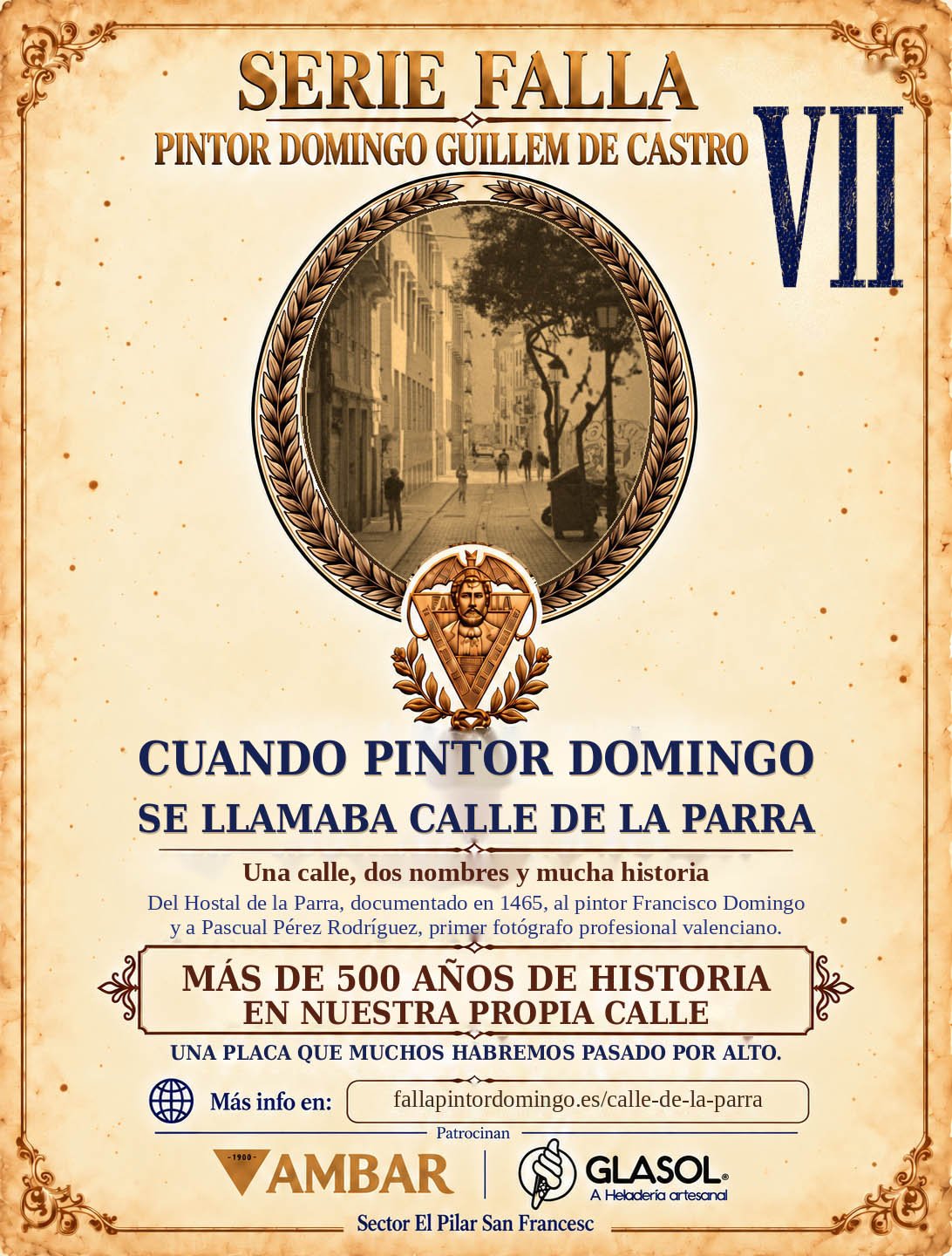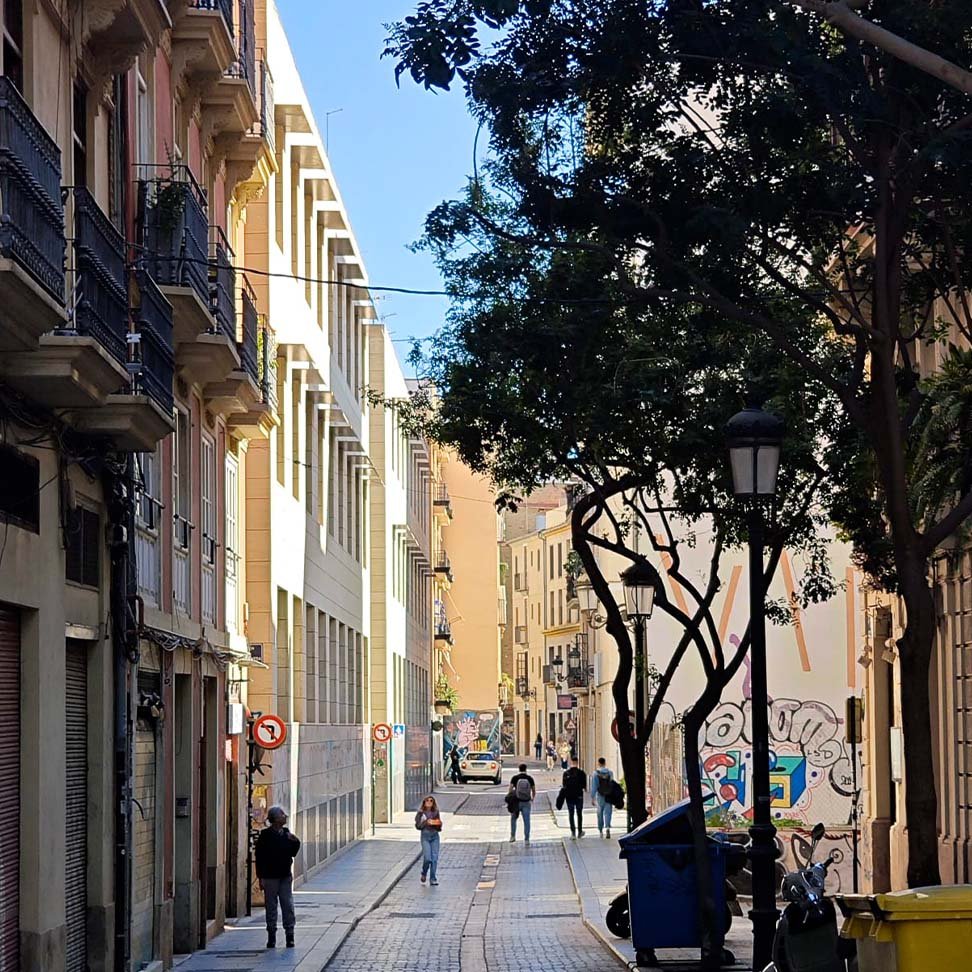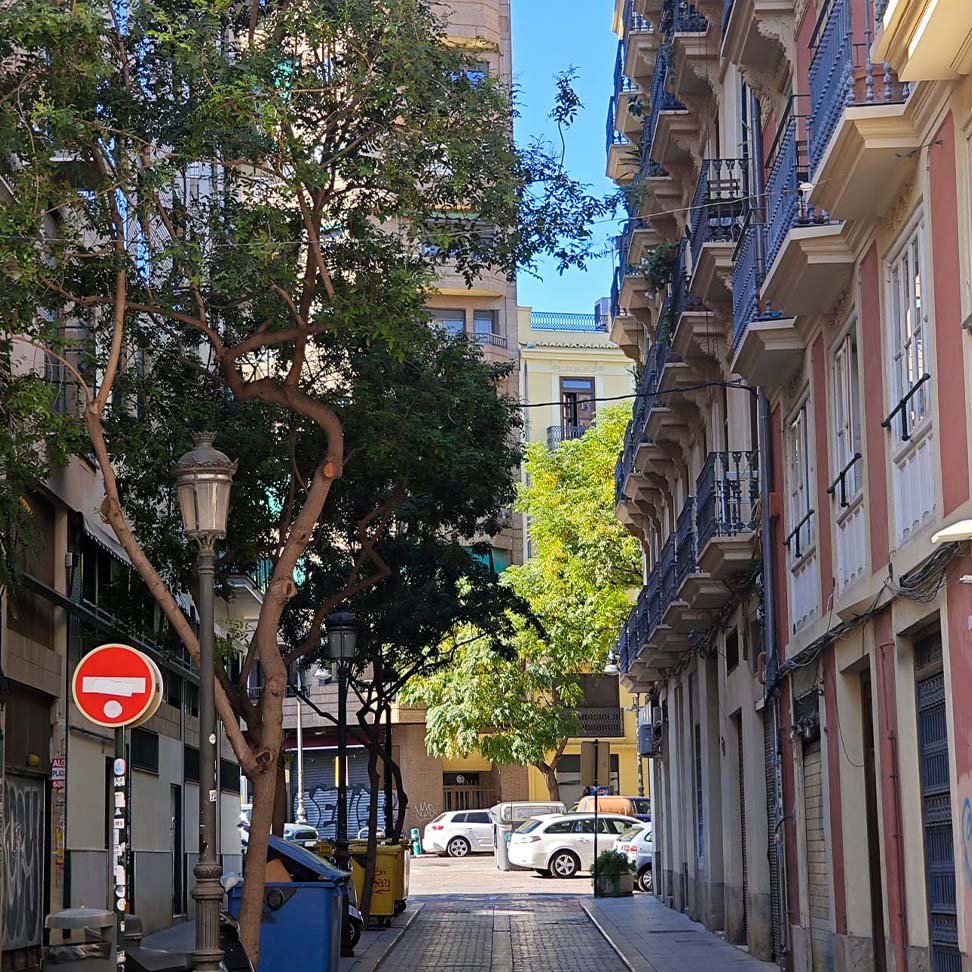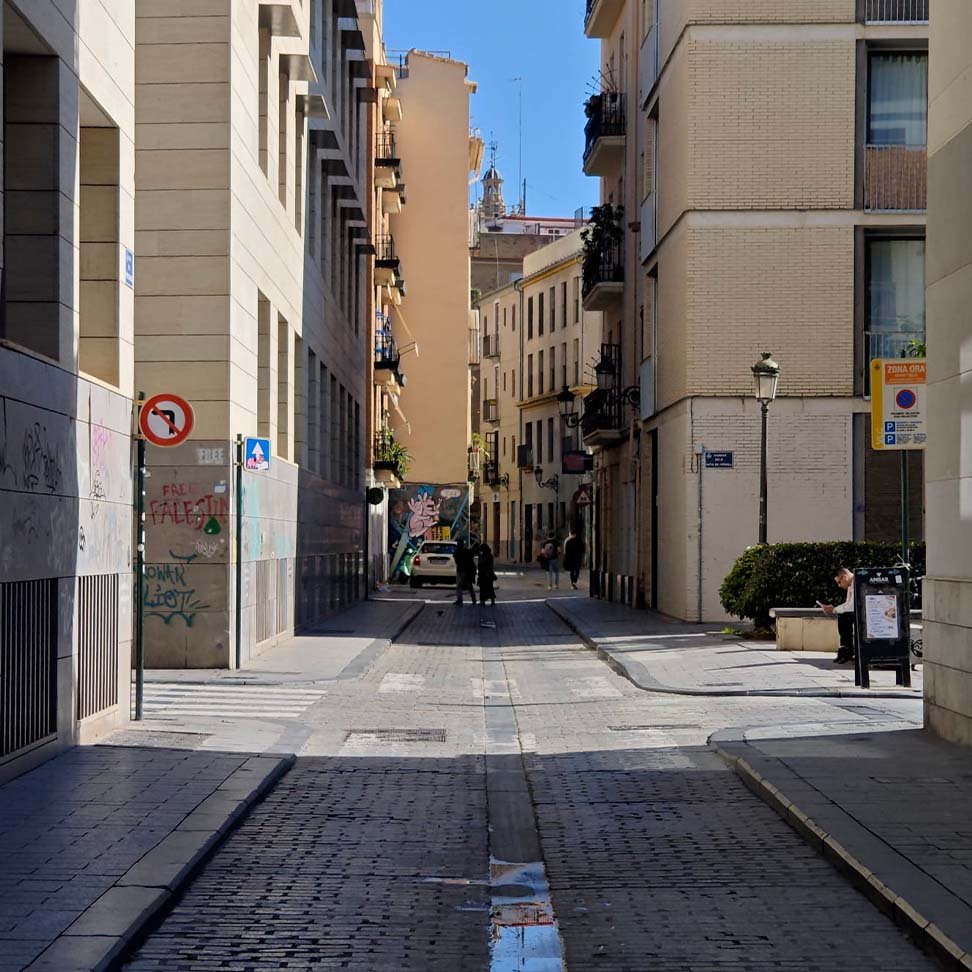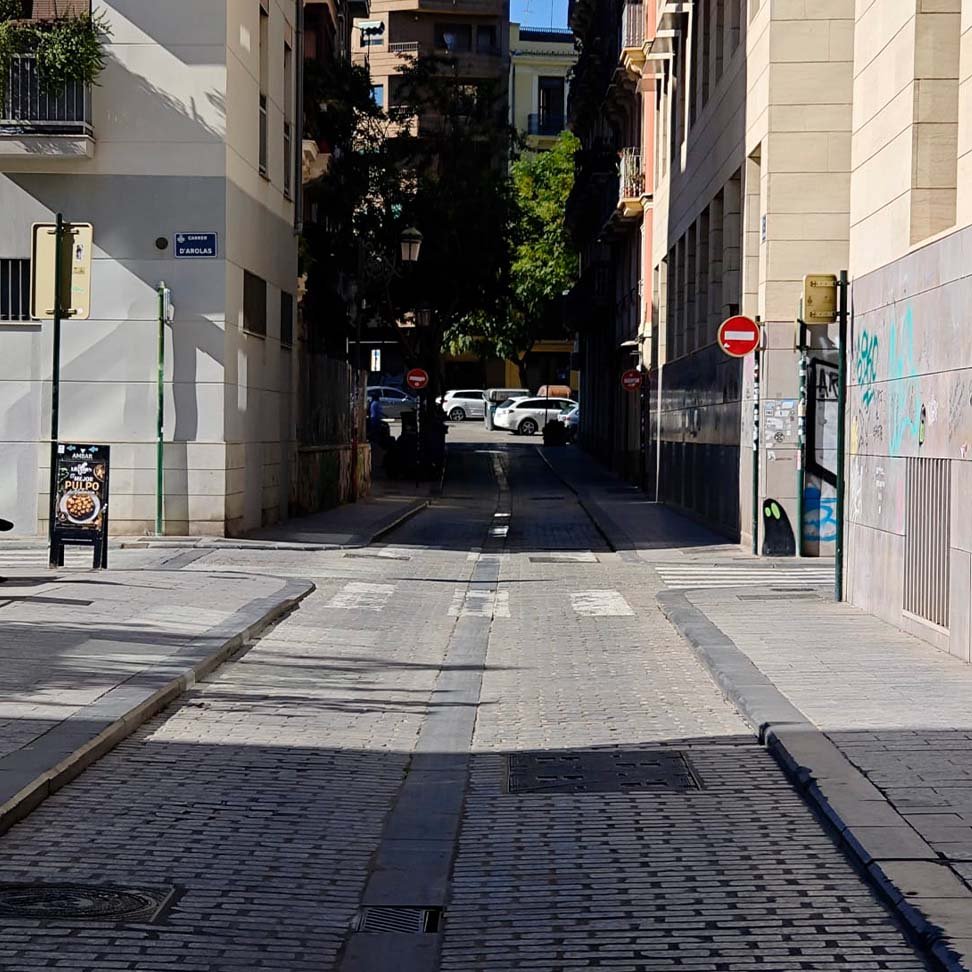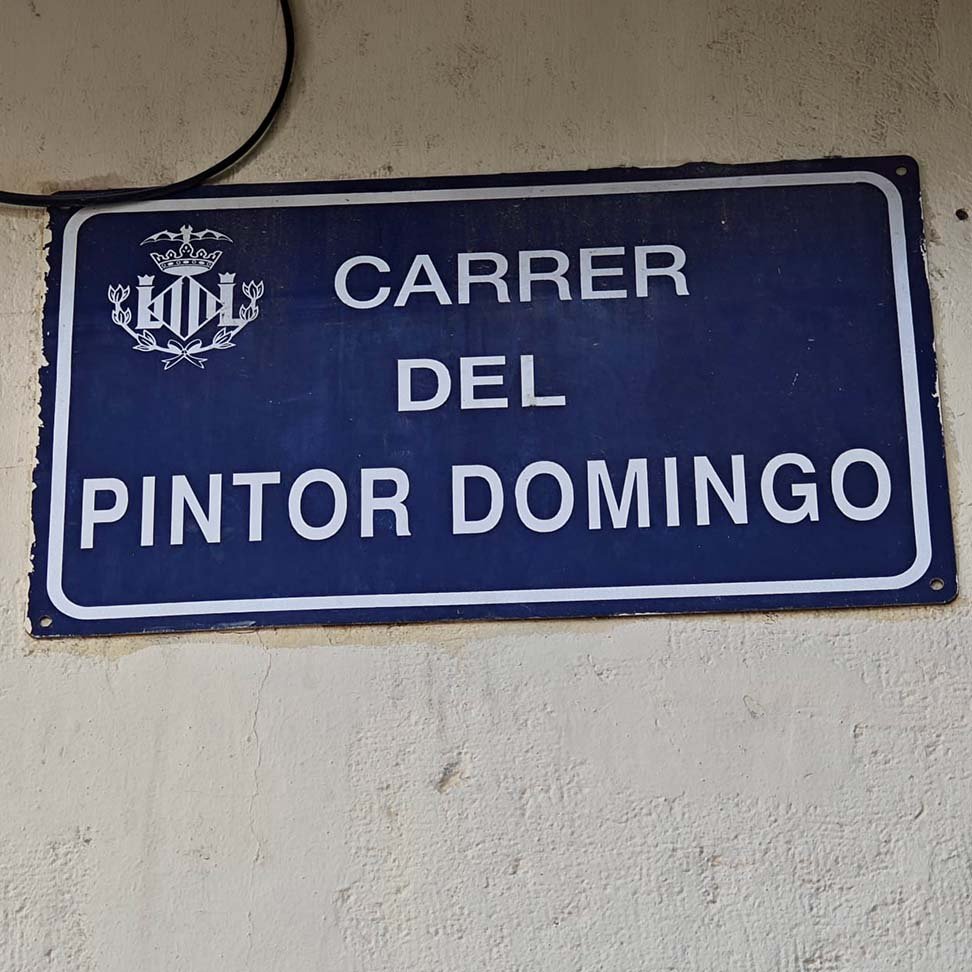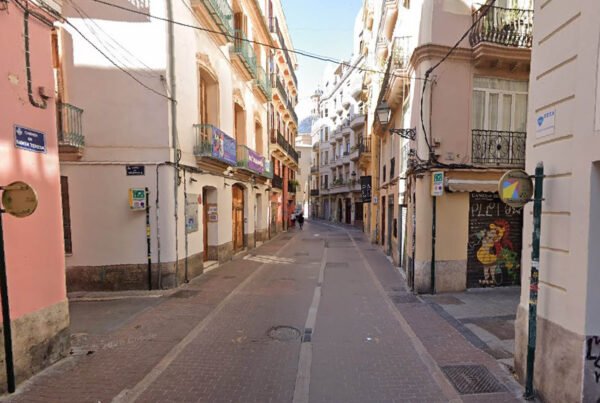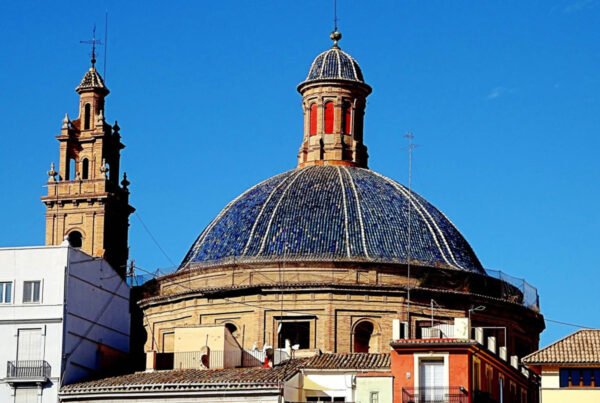

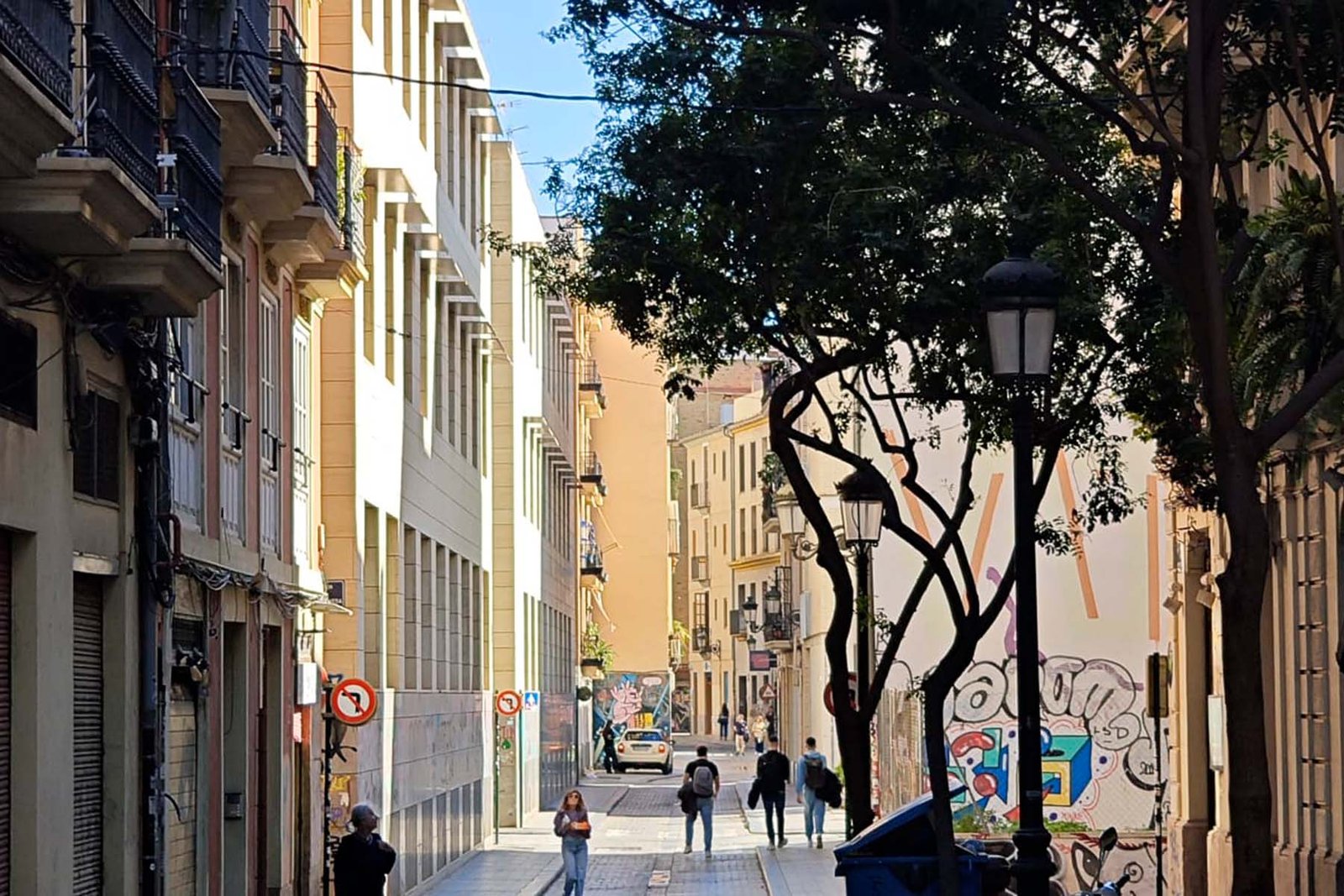
Long before our Fallas association took its name from the street, Pintor Domingo Street was known as Calle de la Parra. A small street in Velluters with more than five centuries of history, it was associated with notable figures in painting and photography and holds a few surprises that many of us probably know nothing about.
Can you imagine a Falla de la Parra – Guillem de Castro?
Well, strange as it may sound, our street wasn’t always called Pintor Domingo.
There was a time when local residents knew it as Calle de la Parra, a name that appears in historical documents dating back to at least the 15th century.
And we’re not talking about a vanished street or some forgotten corner of Valencia. It’s exactly the same street we walk along so often, although its appearance has changed considerably since then.
What’s interesting is that this little street is connected to two important figures in the history of Valencian art: the painter Francisco Domingo Marqués and the photographer Pascual Pérez Rodríguez.
One eventually gave the street his name. The other lived and worked there for more than twenty years. So let’s travel back around 150 years to discover what Calle de la Parra was like and the stories it held.
Calle de la Parra: a name with centuries of history
To picture Valencia in those days, we need to forget about traffic, parked cars and today’s buildings for a moment.
We’re in Velluters, a neighbourhood of narrow streets, homes, craft workshops and small shops. Everyday life revolved around workers, traders and neighbours sharing the same streets and local businesses.
Today’s Pintor Domingo Street, which connects Santa Teresa with Guillem de Castro, was once known as Calle de la Parra. The name is documented as far back as the 15th century — a Hostal de la Parra is mentioned as early as 1465 — and there are also references to the Horno de la Parra, or Parra Bakery. Everything suggests a connection with businesses that once stood in the area, although we cannot say for certain which particular grapevine originally inspired the name.
A grapevine, an irrigation channel and a mustassaf
The scholar Marcos Antonio de Orellana, who reviewed the names of Valencia’s streets in the late 18th century, dismissed the explanation of ours as a «nombre sobrado manifiesto» — a name whose meaning was perfectly obvious. And perhaps he had a point: it must have been quite a grapevine to give its name to an inn, a bakery and an entire street.
Calle de la Parra also appears in documents of a rather less poetic nature. In 1693, the mustassaf — the official responsible for overseeing weights, measures and public order in the city, a position previously held by members of the Eixarch family — issued a ruling concerning the «cequia mare», the main irrigation channel running from Calle de Carniceros to San Cristóbal, in Calle de la Parra. So our street had its own irrigation channel too, just like Santa Teresa.
In any case, the old name survived for centuries, until the city decided in the 19th century to dedicate the street to a Valencian painter.
Francisco Domingo Marqués: the painter who gave our street its name
We’ve probably all said the name Pintor Domingo hundreds of times. But how many of us could explain who he actually was?
Francisco Domingo Marqués (1842–1920) was one of the most prominent Valencian painters of his time. He trained at the San Carlos School of Fine Arts and pursued an important artistic career that took him to Madrid, Rome and Paris, where he gained recognition for his portraits, genre scenes and historical paintings.
His talent was admired by other great artists, including Joaquín Sorolla.
We already explored Francisco Domingo Marqués in detail in the first chapter of «Our History», A portrait of Francisco Domingo Marqués, looking at his life, his work and some fascinating details worth discovering.
But the painter wasn’t the only notable figure associated with our street. Back when it was still called Calle de la Parra, Pascual Pérez Rodríguez, one of the pioneers of Valencian photography, had his home and studio there. And his story is well worth a closer look.
Pascual Pérez Rodríguez: a photographer on our very own street
And here’s one of the most surprising details in this chapter. At number 7 of the old Calle de la Parra, Pascual Pérez Rodríguez lived and worked between 1847 and 1868. He is regarded as Valencia’s first professional photographer.
Born in Valencia in 1804, he was quite a remarkable character: a writer, journalist and photographer. And before all that, a member of the Piarist religious order. At the age of 13, he entered the Piarist seminary on a scholarship, took his religious vows in Peralta de la Sal — the birthplace of Saint Joseph Calasanz — and from 1827 taught humanities at the Piarist school in Valencia. In 1835, he left the order and turned to journalism.
But what particularly interests us is that he carried out his photographic work on our street. We’re talking about the mid-19th century, when having your photograph taken wasn’t a matter of pulling a phone out of your pocket and taking twenty shots until you found one you liked. You had to remain completely still for long seconds, with your head firmly supported and your smile, if you managed one, frozen in place. It was less a photo session than an endurance test.
Photography was still a remarkable novelty. Cameras were complicated devices, the processes required chemical knowledge, and producing an image involved far more work than we can imagine today.
Pascual Pérez experimented with techniques such as the calotype, which made it possible to produce paper negatives and create several copies of the same photograph. From that studio, he contributed to the early development of a medium that would forever change the way we preserve memories.
And to think that all this was happening on a street we now walk along almost without noticing.
From the Parra studio to the first photographic albums
Pascual Pérez Rodríguez’s importance goes far beyond having opened a photographic studio in Valencia.
In 1851, he published the Álbum del Cabañal, a work illustrated with photographs that stands as an important example of the earliest years of photographic publishing in Spain. It was sold in instalments, much like novels of the period.
Those images depicted the landscape and everyday life of Valencia’s old seaside settlement. What made them particularly innovative was that they were photographs produced on paper, at a time when the technique was still in its infancy.
He was also a pioneer in bringing photographic images into the Spanish press, through work associated with the Diario Mercantil de Valencia.
Alongside photography, he pursued an active literary and journalistic career. In fact, together with the poet Juan Arolas and Pedro Sabater, he founded the Diario Mercantil, whose first issue appeared in November 1834, and directed it for many years.
In other words, someone working on our old Calle de la Parra wasn’t content simply to tell stories through words: he also wanted to show them through images.
Pascual Pérez died in Valencia on 30 January 1868. But his connection with our street was not entirely forgotten.
A plaque many of us may have overlooked
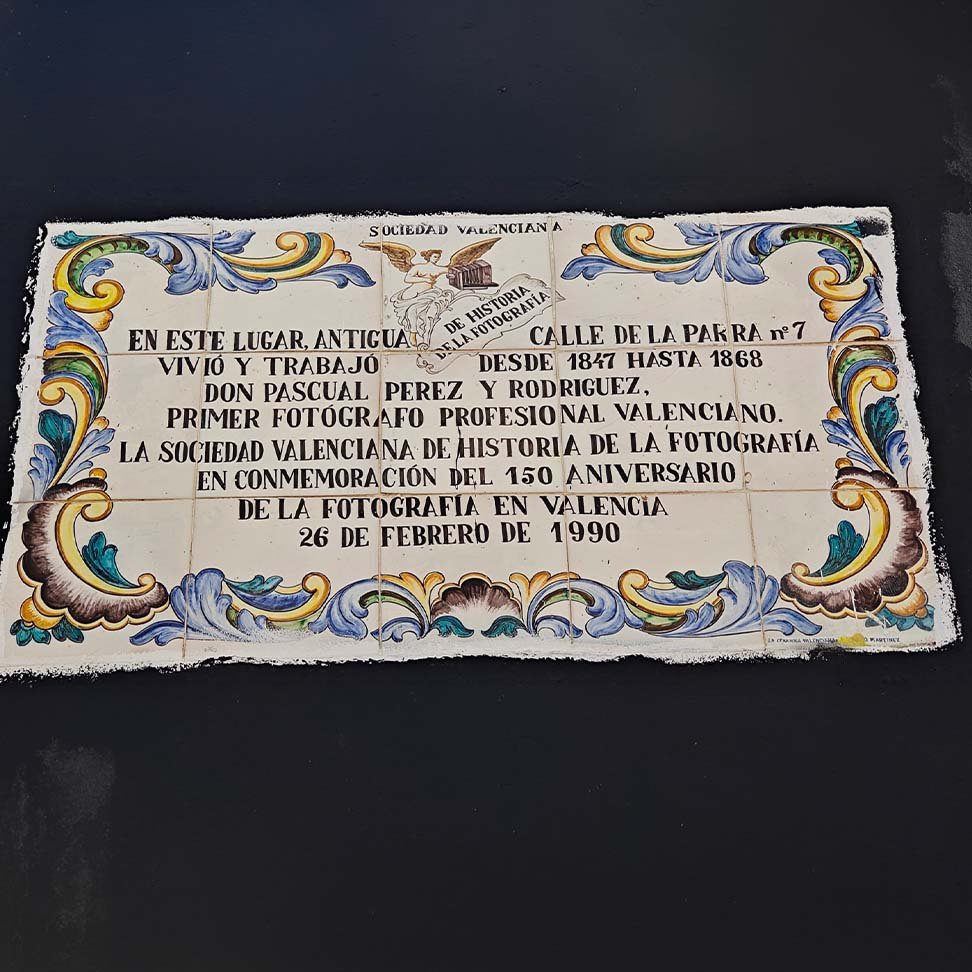
You don’t need to enter a museum or visit an archive to find a trace of this history. On Pintor Domingo Street itself, there is a ceramic plaque dedicated to Pascual Pérez Rodríguez, marking the place where his home and studio once stood. It reads:
“In this place, formerly number 7 Calle de la Parra,
Don Pascual Pérez y Rodríguez lived and worked
from 1847 to 1868,
Valencia’s first professional photographer.”
It was installed by the Valencian Society for the History of Photography on 26 February 1990, to mark the 150th anniversary of photography in Valencia.
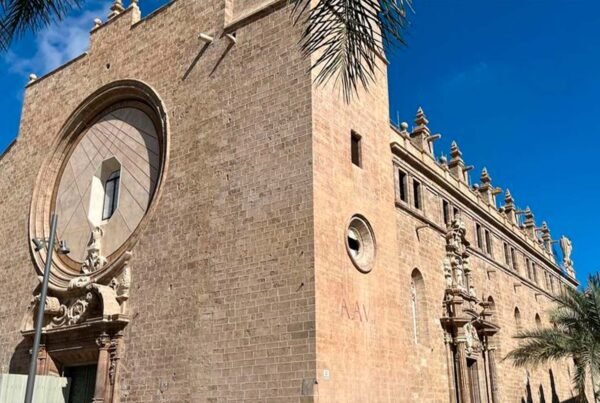
And here’s the detail we particularly love: the plaque is on the wall of the Escuelas Pías, the very school where he studied and taught. More than a century and a half later, the former humanities teacher has, in a way, returned to his old school.
So next time you walk past, look up. It’s one of those little details we see every day but rarely pay attention to.
When the street was also a place of celebration
But the old Calle de la Parra wasn’t just home to artists and photographers.
It also had its own popular celebrations. As documented by the historian Rafael Solaz, during the 19th century the street hosted festivities dedicated to Our Lady of Mount Carmel, organised by a devotional association connected with this religious tradition.
Residents decorated the street with lanterns, garlands and little flags, while local workshops and tradespeople helped with the preparations. Religious prints were even produced and handed out as souvenirs of the celebrations.
It’s not difficult to imagine the atmosphere of a street dressed up for the occasion, with neighbours joining in the preparations and making the most of the festivities to spend time together. And although customs have changed enormously, some things still feel rather familiar.
From Calle de la Parra to Pintor Domingo
Over time, the old Calle de la Parra changed in appearance, residents and eventually its name.
The exact date of the name change is not entirely clear: historian Rafael Solaz places it in 1873, while another historical directory of Valencia’s streets gives 17 January 1887. In any case, the old Calle de la Parra eventually took the name of Francisco Domingo Marqués.
If we follow the date proposed by Rafael Solaz, the painter would have received this honour at just 31 years old, shortly after his success with Santa Clara, which won an award in 1871. Not everyone can boast of having a street named after them at such a young age… and being able to walk along it themselves.
Businesses disappeared, buildings were transformed and new generations arrived who probably never knew the street by its original name.
In our previous chapter of «Our History», dedicated to Santa Teresa and Calle de la Paja, we discovered that the streets around us hold far more stories than we might imagine.
And it turns out that, without going very far at all, we’ve found another.
Best of all, the two streets share more than just a corner: beneath today’s asphalt lie traces of old names, irrigation channels and memories of neighbourhood life.
Over time, the Fallas tradition also found its place at this crossroads. By 1881, there were already records of Fallas activity in the area, at the junction of Pintor Domingo and Santa Teresa. It’s a story we began telling in the previous chapter.
So, after exploring Santa Teresa, we’ve discovered that the street next door has plenty of stories of its own.
The old Calle de la Parra in five facts
-
A name with more than five hundred years of history. Calle de la Parra appears in documents dating back to the 15th century, long before it became Pintor Domingo Street.
-
A street with a bakery and an inn. Historical references include the Hostal de la Parra, documented as early as 1465, and the Horno de la Parra.
-
A painter admired by Sorolla. Francisco Domingo Marqués, born in Valencia in 1842, was one of the leading Valencian artists of his generation. Historical sources disagree on the exact date when the street was renamed.
-
Valencia’s first professional photographer worked here. Pascual Pérez Rodríguez had his home and studio at the former number 7 Calle de la Parra between 1847 and 1868. A ceramic plaque installed in 1990 commemorates his presence.
-
Street celebrations beyond the Fallas. During the 19th century, residents held festivities dedicated to Our Lady of Mount Carmel, decorating the street with lanterns, garlands and little flags.
A street that still holds stories
After discovering all this, it’s difficult to look at Pintor Domingo Street in quite the same way. Behind a name we use almost every day lies a grapevine that gave its name to an inn and a bakery, a painter who had a street named after him at 31, a Piarist who became a photographer, and neighbourhood celebrations that disappeared long ago.
And we can still find traces of that past, such as the plaque dedicated to Pascual Pérez Rodríguez beside the Escuelas Pías. It’s remarkable how a simple plaque on a wall can take us so far back in time.
So next time you walk along Pintor Domingo, look up and find Pascual Pérez’s plaque. And if you’re with someone, you’ll have quite a few stories to share. Who would have thought such a small street had so much to discover?